

Since 3D printing came out in the 80’s there have been numerous claims about using 3D printing for “production”, many of which fell short as machines with high cost of ownership, expensive maintenance, and strict operator training requirements got in the way. In the last decade, metal 3D printing has been taking manufacturing by storm with a new process called binder jetting which enables true production throughput of thousands of parts per week. The key difference in binder jetting is that there is no heat involved in the printing process. No supports are required for printing allowing nested builds to maximize productivity, a feat nearly impossible to achieve with direct-metal laser sintering (DMLS) due to the difficulty of stacking solid metal supports.

Example of Binder Jetting Nested Build with Hundreds of Parts
Binder jetting is anywhere from 10 to 100 times faster than DMLS, the other most widespread metal 3D printing technology. There are 3 main competitors in the metal binder jetting space currently: Desktop Metal, Digital Metal (now part of Markforged), and HP.
History of Binder Jetting
The first stop in the history of binder jetting is explaining the difference between direct-metal laser sintering and binder jetting, the two biggest metal 3D printing solutions. Direct-metal laser sintering, or DMLS, has a pin roller that deposits a microns thin layer of metal powder, then uses a laser to sinter metal powder into solid metal layer by layer. Binder jetting on the other hand is much more like a 2D printer, similarly rolling out a microns thin layer of metal powder, but then an inkjet head passes over the powder rapidly depositing a binder ink into the 2D image of the layer. The speed benefit of binder jetting comes from the fact that layer times are the same regardless of how many parts are in the layer, whereas for more parts laser sintering takes longer as there will be more paths to trace out.


Left: Binder Jetting Machine Diagram, Right: DMLS Machine Diagram
As the diagrams show, the mechanics of the systems are nearly identical, the main difference being that DMLS is using a laser to weld a part, whereas binder jetting is using a rapid inkjet head to bind the metal powder into the 3D shape. The parts then go into an oven to be sintered down into solid metal. The binder jetting technology was initially dominated by ExOne which had the only metal binder jetting solution available from 1998 until 2003 when Digital Metal was founded in Sweden. ExOne was acquired by Desktop Metal in November 2021, and as a result Desktop Metal officially cemented their first mover advantage by consuming ExOne’s customer and printer portfolio. 3D printing giant Markforged acquired another binder jetting competitor, Digital Metal in July 2022.

ProMetal RTS-300, Now Called ExOne, The First Ever Metal Binder Jetting 3D Printer
HP first unveiled a metal binder jetting solution in 2018 but only recently officially launched their metaljet printer at IMTS 2022. Interestingly, HP launched the machine with immediate commercial availability and a grandiose vision of enabling a “digital reinvention of the global metals manufacturing sector.” HP’s software integrated 3D printing solutions lead the industry in traceability and consistency for large enterprises. These 3 companies (HP, Desktop Metal, and Digital Metal) are the biggest and most widely known providers in the binder jetting space.
How do Binder Jetted Parts Compare?
Another common misconception of 3D printing is that the parts made are weaker and more expensive than traditionally manufactured parts. While this can be true for desktop polymer 3D printers, it is certainly not true for industrial 3D printing machinery. 3D metal printed parts are on part with and often superior in strength and surface finish to a casting, and only slightly less strong than a machined part. A common story: a machined part that would otherwise require multiple setups, 5 axis operations with long cycle times, assembly from several components, and complex lightweighting can be metal 3D printed as one whole assembly at a fraction of the cost with no tooling or labor required.
Binder jetted metal parts are most similar to a metal injection molded (MIM) part, which is a process often used in large run manufacturing of metal parts. The process is remarkably similar, with the feedstock and injection process of MIM being replaced by a metal binding printer. Both processes require metal powder as an input, and both processes require that powder to get sintered down by a furnace to remove the binder and densify the final part to achieve its material properties.
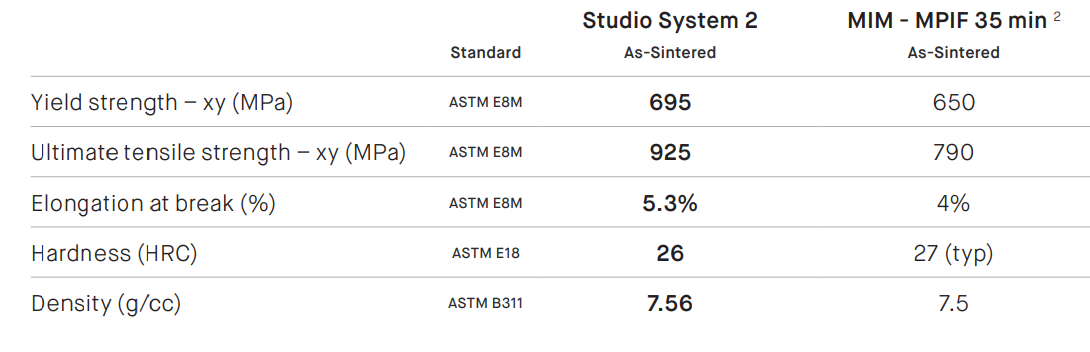
Binder Jetted Desktop Metal Parts vs. Metal Injection Molded Parts Material Properties
Lightweighting in particular is a major benefit of additive manufacturing because it can produce structures that are extremely complex and impossible to machine. Optimal lightweighting lattice structures can be generated digitally using data from part stress or thermal simulations to strengthen the part only where it needs that strength, and cutting away material where it doesn’t.
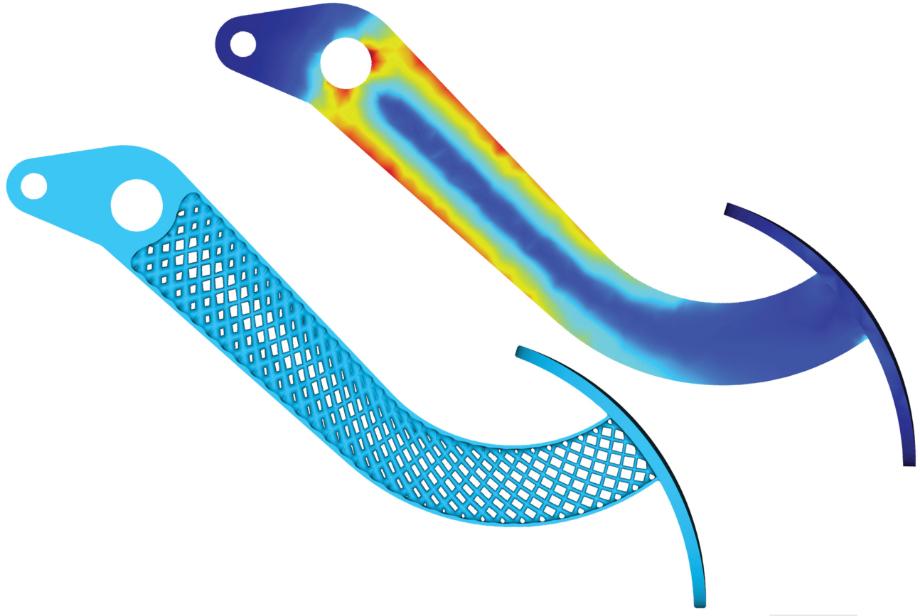
Automotive Brake Pedal Lightweighting Reinforcing High Stress Areas
For a traditionally machined part, lightweighting would add cycle time and waste material, for additive manufacturing the same part is made faster and with lower material cost. One of the most important steps in adopting additive manufacturing is training your team to take advantage of the full benefits of 3D printing. With 3D printing we can often lightweight a part, add functionality like conformal cooling, embedded electronics, or internal passages, all while producing the part more quickly and affordably.
What Does the Competition Look Like?
In spite of recent entrants to the binder jetting space, Desktop Metal has been the most prolific and widely adopted solution due to their acquisition of ExOne and a broad machine catalog. Desktop Metal is a step ahead in powder availability, support, and operator knowledge base, but with major acquisitions happening elsewhere in the industry their market dominance will be challenged significantly in the coming years.
 HP’s Metal Jet System, Which Features Highly Automated Hardware and Traceability
HP’s metal jet system is currently running in companies Cobra Golf, Legor Group, and Volkswagen, the latter of which set itself a target of producing 100,000 additively manufactured components at its Wolfsburg facility each year by 2025. The company has also announced new partners and customers including hydraulic systems manufacturer Domin Digital Motion, Lumenium, Schneider Electric, and GKN.
Digital Metal’s P2500 system is currently running at Honeywell, Bosch, Volvo, Siemens, Koenigsegg, CETIM, and Montfort. Their recent acquisition by Markforged in July of 2022 has been making waves in the industry as Markforged, a publicly traded industrial polymer 3D printing giant, is seriously positioning itself to take on industrial metal 3D printing as well.
 Desktop Metal Leads the Industry in Installations
Desktop Metal’s shop system is currently running at Ford, PGV, Wall Colmonoy, Eaton, and Lumenium. Desktop Metal currently has the most binder jetting machine installs of any of their competitors as well. They recently announced a sweeping partnership with SolidCAM to help accelerate the adoption of additive manufacturing for traditional machine shops with additional support and software resources.
Direct comparison of specs:
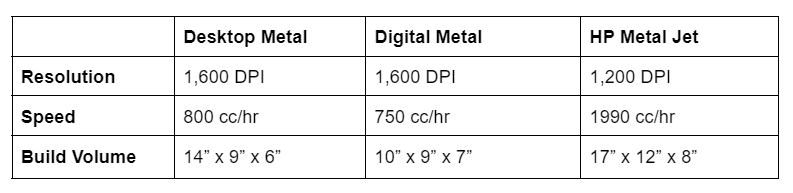
If you have any more questions regarding the solutions in the binder jetting space, feel free to reach out to our team at any time. All 3 companies have relatively similar capabilities in production metal printing, but the post-processing and support is where they become easier to differentiate.
What Does the Future of Manufacturing Look Like at Your Company?
More companies than ever have been looking into binder jetting to onshore supply chains, cut lead times, and minimize unnecessary machining due to labor shortages. 3D Printed Parts specializes in machine sales as well as short-run manufacturing for companies looking to fill urgent needs.
As a reseller of Desktop Metal and other machinery, our team is happy to help anyone interested in the binder jetting process evaluate the solutions available. Do you have a specific project or application you want to run a case study on? Want to get parts benchmarked and calculate time to ROI? Our team of 3D printing experts is ready to assist you.
Whether you’re looking at 3D printing a small handful of parts and production means a few hundred prints per year, or you need to print a vast catalog of complex parts and production means tens of thousands of parts per year, our team is dedicated to finding your company the right solution to stay competitive and strengthen your business for the long term.
Recent Comments